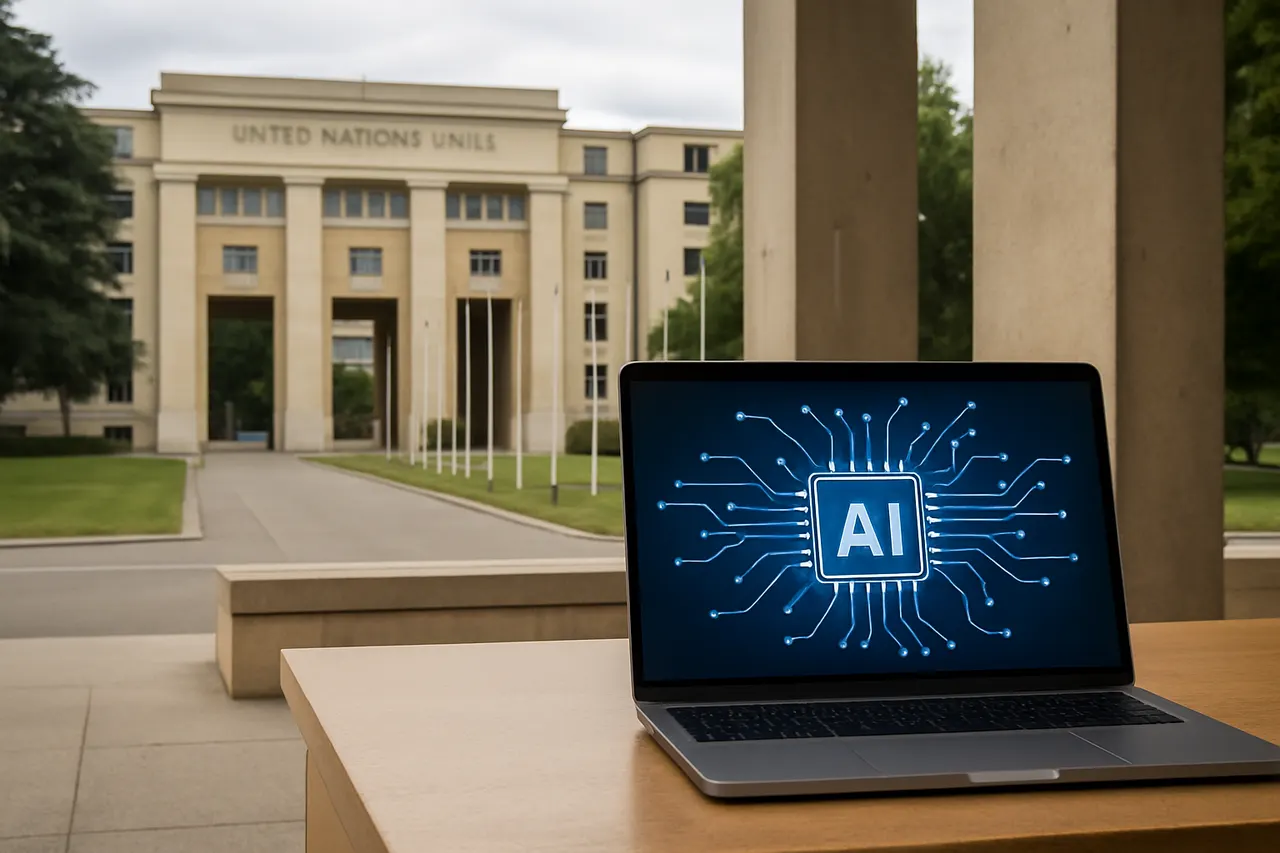
On July 6, 2026, UN Secretary-General António Guterres called for comprehensive global governance of Artificial Intelligence (AI) during the inaugural UN Global Dialogue on AI Governance held in Geneva. He emphasized the urgent need for far-reaching controls as powerful AI chips originally designed for civilian use increasingly appear on battlefields, where autonomous weapons or “killer robots” have become commonplace.
Guterres stressed that any future international agreement must be trustworthy and prioritize safety, especially protecting children from digitally-generated manipulation and abuse. Echoing this, Annalena Baerbock, President of the General Assembly, urged collective action to combat the darker aspects of AI, noting that 99% of deepfake content is sexual in nature and 96% targets women and girls.
The UN chief highlighted additional priorities including guaranteed access to self-learning AI technologies for developing countries and a commitment that all AI data centers be powered by renewable energy by 2030. He referenced the UN AI Environmental Transparency Initiative, warning that by 2030 AI could consume more electricity than all but five nations and use enough water to meet the needs of 1.3 billion people in sub-Saharan Africa for a year.
Guterres recalled his initial call for AI regulations made to the General Assembly in 2017 and underscored the risks of fragmented rules, stating, “When countries align on how to test systems, measure risk and assign responsibility, safety travels with the technology. When they do not, a patchwork of incompatible rules raises costs, divides the world – and protects no one.”
To address these challenges, he announced that over 20 countries have backed his initiative for a UN-supported Global Network for Exchange and Cooperation on AI Capacity Building.
The UN Independent International Scientific Panel on Artificial Intelligence warned in June 2026 that AI could cause catastrophic harm either independently or through malicious use, outpacing scientific understanding and governmental adaptation.
Guterres concluded with a cautionary note: “It sounds like science fiction, but it's a real possibility, and it could change the world in ways that we don't understand yet, and it could change the power dynamics of our planet in ways that require our attention.”
Loading comments.